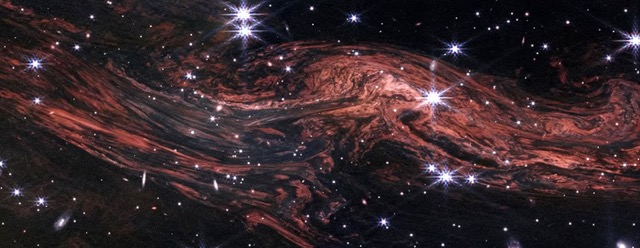
Everything we can see and touch is made from material produced by thousands of dying stars that contributed elements to the cosmic dust, or interstellar medium, from which the Sun and planets were created about 4.5 billion years ago. The process that created the ISM and the Earth was not a one-time event. We did not come from nothing; we came from a process that is ongoing. Stars are still actively dying and exploding, sending new elements into the interstellar medium that will eventually become new suns and planets.
Our solar system will follow the same path. Billions of years from now, our Sun will deplete its fuel and expand into a red giant. The inner planets will be consumed or otherwise destroyed by the expanding Sun. As the Sun loses mass, the outer planets will move outward and their orbits will become increasingly unstable. Eventually, everything we see as permanent will be gone and exist only as dust.
That dust—what was once our solar system—will mix back into the interstellar medium. Given enough time, some of it will contribute to the formation of another solar system with planets, and under the right conditions, life may form again. I find this comforting. All life that has ever lived on Earth—dead or alive—will be part of that dust when our solar system is gone.
Just think of this: the material that makes up our bodies came from thousands of dying stars, and it is possible that there was life on planets orbiting some of those suns. That would mean the elements that make up us may once have been part of life forms from long-extinct civilizations and long-extinct solar systems. And the material that makes up our bodies may one day appear in other life forms in the incomprehensibly distant future.
It’s an endless cycle—a process that will continue in much the same way until the universe itself ends. And even then, new cycles may emerge, governed by physics that is currently unknown to us. Terror Management Theory suggests that humans cope with the anxiety of death by turning to religion. But being part of a cosmic, repeating cycle of dust creation, aggregation, and eventual return to dust strikes me as reassuring. We are not only the here and now; we are also part of a much grander system—a Grand Cycle.
A few details about that Grand Cycle.
The dust that built planets—and ultimately life—came from a layered stellar history: carbon and oxygen forged in ordinary stars; silicates and metals produced in massive stars and supernovae; trace heavy elements created in rare, extreme events. This material comes from many sources and is constantly mixed, making it impossible to trace any single origin. The dust that ultimately formed the solar system was shaped by thousands to millions of separate stellar events spread across deep time.
Think about that. The material that makes up everything around us—including our own bodies—had its origin in an almost unimaginable number of stellar lives and deaths.
That doesn’t make me feel insignificant. I find it reassuring. It makes me feel connected to something larger than myself—a cosmic process that repeats, not once, but endlessly. The elements that make up my body will not simply vanish; they will participate in solar system after solar system, long after this one is gone.
 Confronting Mediocrity